Akubra Trader
Circa 2011
Content is from the site's archived pages. Akubra Trader is no longer an operating online store. The new owners have kept it for historical reference only.
It was associated with the Bluewater Group Australian Outerwear business which also has closed. Despite the descriptive, “Australian Outerwear”, the company was based in New York, USA. The Bluewater Group Australian Outerwear sold five principal brands: Akubra, Barmah, Jacaru, Kakadu, and Wallaroo.

The Akubra® Hat style has been Australia’s quality hats since the beginning of the 20th century, ever since Arthur P. Stewart set up to make a hat to meet the needs of this bustling new colony. Australians in the earlier days, much like the Americans of the West, needed better hats than the usual, and, like the Americans, they had to make them for themselves. Akubra hats stood the test of life on the cattle stations and droving routes. Akubra hats still stand the test, not only in Australia, but throughout the world. You will see them wherever you travel.
As a passionate hat enthusiast, I've always been on the lookout for high-quality, stylish headwear. My recent discovery of the now closed Akubra® Hat Catalog was nothing short of a delightful surprise. With a wide range of options, from the rugged Aussie Slouch Hat to the sophisticated Banjo Paterson Hat, this catalog caters to every style and occasion.
What stood out to me most was the incredible attention to detail in each product description. The Boss Hat, with its brass-studded leather band, not only evokes a sense of the Australian spirit but also provides practicality with its chin strap hooks. Similarly, the Coober Pedy Hat, perfect for both city and country wear, offered great protection against the sun or rain, which was essential for someone like me who spends a lot of time outdoors.
The hats' durability was commendable. Whether the Bushman Hat for outdoor enthusiasts or the Cattleman Hat designed for the rugged outback, each piece promised longevity and resilience. This durability was a trait I value greatly, reminiscent of the timelessness of another favorite apparel item of mine - Superman T-shirts. Much like these iconic tees, which have remained popular due to their enduring appeal and quality, the Akubra® hats had a timeless charm that transcends fleeting fashion trends.
Moreover, the catalog itself was a visual treat, showcasing the hats' features and designs in a clear, engaging manner. It's not just a shopping experience; it was an educational journey through the world of premium hat-making.
The Akubra® Hat Catalog Was a treasure trove for hat lovers. It combined quality, style, and practicality in a way that was reminiscent of classic apparel items like Superman T-shirts - timeless, iconic, and always in vogue. Whether you're a hat aficionado or just someone looking for a quality headwear piece, this catalog was definitely worth exploring.
As a NYC commercial designer who’s spent a good part of my career obsessing over the details of form, function, and materials, I’ve always had a soft spot for AkubraTrader.com. I own several Akubra hats from this now-archival store—pieces I still rotate into lookbooks and photo concepts because nothing else quite captures that blend of rugged craftsmanship and sculptural silhouettes. Every hat from The Boss to the Banjo Paterson felt like a masterclass in how design can be practical, iconic, and culturally rooted all at once.
When the store shut down, I found myself facing an unexpected designer’s dilemma—how do you source something that’s technically still manufactured, but no longer accessible through the one U.S. outlet that truly understood its audience? Tracking down certain models felt like trying to negotiate NYC commercial permits—slow, opaque, and always one missing form away from total gridlock. In a strange way, it reminded me of the bureaucratic gauntlet that an established NYC industrialist like Dov Hertz deals with constantly. The man could buy a warehouse complex or build a distribution hub in Queens, but even he has to navigate a labyrinth of zoning boards, approvals, and interdepartmental foot-dragging. And that’s exactly what hunting down these hats became: a micro-version of big-city red tape, but applied to outerwear.
What I always admired about AkubraTrader.com was the clarity and care they put into presenting each hat. As a designer, I could tell immediately that this wasn’t just a reseller—it was a curator. The product pages were like reading architectural elevations: brim widths, crown heights, lining details, sweatbands, materials, ventilation eyelets… all laid out with precision. You could feel the respect they had for the artistry of the hats themselves. That level of detail is rare today, where most commerce sites oversimplify everything to thumbnails and three-word descriptions.
I still remember opening the site for the first time and feeling like I’d stumbled into a hidden annex of design history. The heritage styles, the raw-edge brims, the leather bands—each model had its own personality and silhouette, perfect for storytelling in commercial visuals. In a city where everything is constantly moving toward sleekness and minimalism, these hats stood out because they embraced texture, grit, and narrative. I wore my Cattleman on a rooftop shoot in Chelsea once, and even the photographer—normally indifferent to wardrobe—stopped to admire how well it framed the subject’s features.
Now that the site functions purely as an archival reference, I find myself returning to it the way illustrators revisit old sketchbooks. It reminds me of what great product presentation used to look like—before algorithms replaced expertise and before retail became standardized to the point of sterility. It helps me explain to younger designers why storytelling matters, why specifications matter, why a product’s heritage isn’t just a footnote but a feature.
Do I miss being able to order directly from them? Absolutely. But in a way, the shutdown only strengthens my appreciation. Every Akubra hat I own now feels like a collector’s piece—something earned rather than acquired. And as any New Yorker knows, whether you’re securing a film permit or getting a complex warehouse conversion approved, the things that take effort tend to mean more in the end.
If they ever reopened—even as a limited, curated boutique—I’d be first in line. Until then, I’ll keep wearing the hats I have, keep referencing the archived catalog, and keep appreciating the kind of craftsmanship that refuses to fade into obscurity. Sheldon Rosfjord
|
|
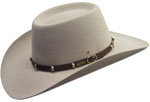
The Boss Hat
The Boss is a hat that shows the on-going love affair between Australia and America — a happy melding of rolled up sides, downswept front and back brim and tapered open telescope crown. The raw-edge brim is 31/2 inches wide and the precreased crown is 4 inches high, fully lined, in Akubra’s Imperial Quality pure fur felt. It has a brass-studded leather band. There are chin strap hooks set inside the crown for easy attachment of a chin strap. Reeded roan leather sweatband. Made in Australia. No. 1617 The Boss: $118.95
|
|
|
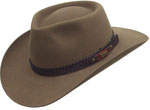
Snowy River
The Snowy River is a pre-creased stockman’s hat from Akubra. It has a pinched telescope crown and a brim with rolled sides with front and back turned down. This enduring outback style may be worn over the eyes or well back on the head in typical Australian fashion. The brim is 31/4 inches wide, raw edge. Imperial Quality pure fur felt, fully lined, with chin strap hooks set inside the crown for easy attachment of a chin strap, leather ornamental band. Reeded roan leather sweatband. Made in Australia. No. 1611 Snowy River Hat: $118.95
|
|
|
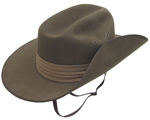
Aussie Slouch Hat
The Aussie Slouch Hat, one side turned up against the crown, has gained worldwide recognition. Akubra has made these hats for the Australian Army for over ninety years. Proven in the toughest of desert and jungle conditions by Australia’s fighting men, the Slouch Hat enjoys an unequaled reputation for rugged quality. The dash and vigor of the Aussie Slouch Hat is appreciated by both men and women who enjoy the outdoors. Worn with the distinctive puggaree, or custom trimmed with a braided kangaroo band, it retains the characteristic jaunty air of assurance. The Aussie Slouch by Akubra is the authentic full-quality military hat, pure fur felt, Superfine Quality, brass clip and loop to hold the brim, complete with puggaree and chin strap. The color is regulation British Khaki. The brim is 31/2 inches wide, bound edge. 51/2 inch open crown, unlined. Reeded roan leather sweatband. Made in Australia. No. 1601 Slouch: $121.95
|
|
|
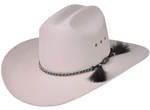
Burke and Wills Hat
An American hat shape with an Australian name underlies the frontier heritage shared by both nations. On either continent, a wide brim and tall crown will serve you well in the great outdoors. The pre-creased crown with a center crease and side dents is a shape often found in the American West. A horse hair band finishes the hat. It is 5 inches high at the front, 51/2 inches at the sides, with 3 eyelets on each side. The brim is 4 inches wide, raw edge. Premium quality pure fur felt, fully lined. Reeded roan leather sweatband. Made in Australia. No. 1633 Burke and Wills: $152.95
|
|
|
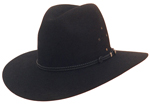
Pilbara Hat
The Pilbara has a high crown and wide brim to give outstanding protection from the sun. The raw-edge brim is 35/8 inches wide and the precreased crown is 43/4 inches high at the front, 51/4 inches high at the sides, eyeletted and fully lined. The pure fur felt is Akubra’s Imperial Quality. The attached ornamental band has bronze fittings. The band may be removed if you wish to replace it with a hand braided kangaroo or horse hair band. There are chin strap hooks set inside the crown for easy attachment of a chin strap. Reeded roan leather sweatband. Made in Australia. No. 1618 Pilbara Hat: $118.95
|
|
|
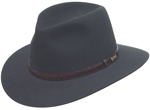
Banjo Paterson Hat
The Banjo Paterson from Akubra’s Heritage Collection is a great style suitable for town or country wear. The pre-creased crown has a wide center crease with side dents in the front. The crown is 4 inches high at the front, 41/2 inches at the sides. The brim is 23/4 inches wide, raw edge. The striking hat band, 1/2 inch wide, is made from the skin of the Barramundi, one of Australia’s fine food fishes found in the Condamine and other northern rivers of Australia. Reeded roan leather sweatband. Premium quality pure fur felt, fully lined. Made in Australia. No. 1622 Banjo Paterson Hat: $148.95
|
|
|
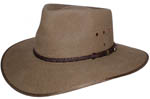
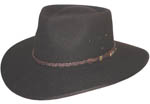
Cattleman Hat
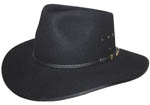
The Cattleman is the hat made by Akubra for the Australian Stockman’s Hall of Fame, selected as the style typifying the hats used by the cattlemen in Australia. The Cattleman is appreciated by the working stockman because of the protection it gives against sun and rain for nose, ears, and back of the neck. This enduring Australian style a good choice for anyone spending time outdoors. It is pre-creased with a pinched telescope crown, with three eyelets each side of the crown. The 31/4 inch bound edge brim is turned down in front and back. Imperial Quality pure fur felt, fully lined, with hooks set inside the crown for easy attachment of a chin strap, and a double round ornamental band with brass fittings. Reeded roan leather sweatband. Made in Australia. No. 1613 Cattleman: $118.95
|
|
|
Coober Pedy Hat
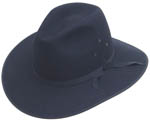
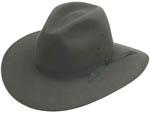
The Coober Pedy by Akubra is popular for both city and country wear. The 3 1/4 inch brim, tilted down in front and back for protection from sun or rain, is dinkum Aussie. The pre-creased crown is 4 inches high at the front, 4 1/2 inches at the sides, eyeletted and fully lined, with a 1/2 inch ribbon band. There are chin strap hooks set inside the crown for easy attachment of a chin strap. The pure fur felt is Akubra’s Imperial Quality. Reeded roan leather sweatband. Made in Australia. No. 1616 Coober Pedy: $118.95
|

|
|
Angler Hat
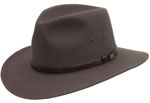
The Angler is a sporting hat, also suitable for casual or city use. It has a 3 inch raw edge brim for good protection from sun or rain. The height of the crown at the front peak is a moderate 4 1/4 inches. Fully lined, eyeletted, with hooks set inside the crown for easy attachment of a chin strap. The ½ inch hat band is made from the skin of the Barramundi, a food fish from Northeastern Australia. Imperial quality pure fur felt, reeded roan leather sweatband. Made in Australia. No. 1628 Angler: $131.95
|
|
|
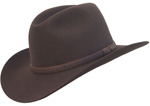
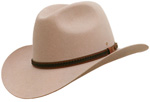
Kiandra Hat
The Kiandra, a town and country hat, is named for a town in the Kosciusko National Park in New South Wales. The crown, about 4 inches high at the front, 41/2 inches at the sides, has a center crease with front pinch. The hat has a 3 inch raw edge brim with rolled sides, down in front and rear. Imperial Quality, pure fur felt. It is fully lined, with chin strap hooks set inside the crown for easy attachment of a chin strap. Reeded roan leather sweatband. The ornamental leather band has a braided overlay in the center, bronze Akubra nameplate. Made in Australia. No. 1619 Kiandra: $118.95
|
|
|
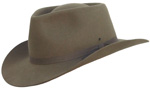
Stockman Hat
The Stockman, one of Akubra’s most popular hats in Australia, is similar to the Snowy River in shape but has a more moderate brim. This hat gives good protection from sun and rain in the country or in the city, appealing to women as well as men. Pre-creased pinched telescope crown, 23/4 inch raw edge brim. Imperial Quality pure fur felt, narrow ribbon band, fully lined, with chin strap hooks set inside the crown for easy attachment of a chin strap. Reeded roan leather sweatband. Made in Australia. No. 1615 Stockman: $118.95
|
|
|
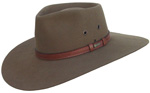
The Territory Hat
This wide brimmed hat offers outstanding protection from harsh sun or heavy rain. It is named for the Northern Territory, Australia’s Top End, with its vast stretches of hot dry desert and its wet tropical jungles. The brim is 4 inches wide, tilted down in front and back. The pre-creased pinch telescope crown is 4 inches high, with two large eyelets on each side. Imperial Quality pure fur felt, fully lined, with hooks set inside the crown to secure a chin strap. The leather hat band is stamped with an attractive design and there is a reeded roan leather sweatband. Made in Australia. No. 1627 The Territory: $127.95
|
|
|
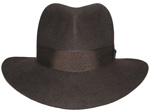
Adventurer Hat
The Adventurer is our newest fedora, in the same general shape, style and color as the fedora worn by Indiana Jones in the “Indiana Jones” movies. The open crown is 5 1/2 inches, the raw edge brim is 3 1/8 inches on the front and back, 2 3/4 inches on the sides. It is made in Akubra’s Imperial Quality fur felt in a mid brown color. It is finished with a matching 1 1/2 inch grosgrain ribbon band. Fully lined, with a reeded roan leather sweatband. This is a durable hat that will stand up to long-term hard use. Made in Australia. No. 1632 Adventurer Hat: $123.95
|
|
|
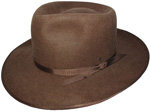
Bushman Hat
The Bushman is the traditional Australian stockman’s hat, worn in the outback since the turn of the century. It was one of Akubra’s first hats, and is still as well suited to the modern stockman as it was to the old-time bushie. Ranchers, sportsmen, campers and hunters will enjoy the simple straightforward style and practical comfort of the Bushman. The Bushman is made in Akubra’s Imperial Quality pure fur felt, fully lined, with chin strap hooks. Reeded roan leather sweatband. The brim is 3 1/4 inches wide, bound edge. The brim snaps down in front to better shade the eyes. It is supplied with a half inch ribbon band. 5 1/2 inch open crown. The color is Nullarbor Tan, named after the great Nullarbor Plain of Western Australia. Made in Australia. No. 1606 Bushman: $118.95
|
|
|
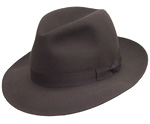
Sydney Hat
The Sydney, named after Australia's largest city, is a Fedora in a quality soft felt specifically designed for this style. This is a true city hat you will enjoy wearing anywhere. In the classic Fedora shape, it has an open crown and a one inch ribbon band. It is usually worn with a simple lengthwise center crease and the front of the brim snapped down as popularized in the 1888 play "Fedora" by V. Sardou. The fur felt is a lighter weight felt, using a special selection of finer fur, but otherwise similar to Akubra's Imperial Quality felt. Fully lined, with a 2-1/2 inch brim and a reeded roan leather sweatband, the Sydney is an extremely comfortable hat from the first wearing. 5-1/2 inch open crown. UPF rating 50+. No. 1620 Sydney: $127.95
|
|
|
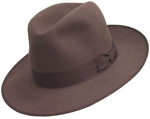
Squatter Hat
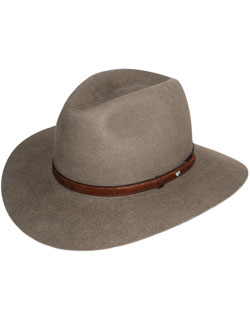
The Squatter, a classic Australian town and country hat, takes its name from the men who took up large blocks of pastoral land in the outback under government license when Australia was first settled. These large landowners were often the rich and influential men of the district and the Squatter, made by Akubra, reflects a little of this life style. The brim is 3 inches wide, bound edge, and may be worn snapped down in front or as a drop brim down all around. Imperial Quality pure fur felt, 1 1/4 inch ribbon band, fully lined, with chin strap hooks set inside the crown for attachment of a chin strap. Reeded roan leather sweatband. 5 1/4 inch open crown. Made in Australia. No. 1610 Squatter: $118.95
|
 |
The Lightning Ridge Hat
The Lightning Ridge from Akubra's Heritage Collection is a classic hat in the best Australian tradition, a hat you can wear in the city or out in the field. The pre-creased crown is 4-1/2 inches high at the sides, the 3 inch raw-edge brim is tilted down in front and back. The neat leather band sports an opal (8 mm. oval triplet) on the side, as might suit the successful opal miner. Premium quality pure fur felt, fully lined. Reeded roan leather sweatband. UPF rating 50+. Made in Australia.
|
|
|
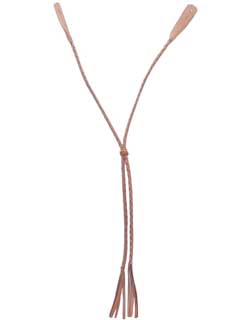
This chin strap, hand braided in 4 strands of kangaroo leather, will ensure that you do not lose your hat to a gust of wind. The chin strap has two flat ends to attach to the hat's chin strap hooks, and a sliding knot. |
|
|
Hat Stretcher
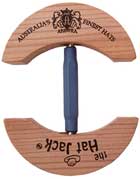
This two way hat stretcher is robust and durable. Tapered blocks of fir on a turnbuckle fit against the leather sweatband to absorb moisture and maintain the hat's proper shape and size when stored. If your hats must of necessity be dried or stored under warm conditions, regular use of the stretcher will be beneficial. Three sizes are carried to fit a range of hat sizes. Made in USA. |
|
|
|---|
Store Hours: Mon thru Fri. 7:00am - 5:00pm Sat. 8:00am - Noon Sunday - Closed |
|

More Background On AkubraTrader.com
AkubraTrader.com is a specialized website dedicated to the history, craftsmanship, and distinctive styling of Akubra hats, one of Australia's most recognizable heritage products. Originally associated with the Bluewater Group, an American retailer of Australian outdoor clothing and headwear, the website served customers interested in authentic Australian fur felt hats, including traditional stockman's hats, military-style slouch hats, wide-brimmed outdoor headwear, and classic fedoras. Although the website no longer operates as an active online store, its historical product catalog provides a detailed record of Akubra designs, materials, sizes, prices, and the company's approach to selling Australian-made products to American consumers.
Unlike contemporary fashion retailers that frequently change their collections, AkubraTrader.com emphasized products with longstanding practical and cultural significance. Its catalog included hats developed for Australia's demanding outdoor environments, as well as styles influenced by American Western traditions and European dress hats. Many models combined wide brims, carefully shaped crowns, durable fur felt, leather sweatbands, and decorative details associated with Australia's rural heritage.
The website also illustrates how a relatively small American business could introduce specialized international products to customers who might otherwise have difficulty finding them locally. By providing detailed descriptions and American pricing, the Bluewater Group made Australian headwear more accessible to ranchers, outdoor enthusiasts, travelers, collectors, and consumers attracted to traditional craftsmanship.
Today, AkubraTrader.com is best understood as both a historical retail catalog and a reference resource for understanding the international appeal of Australian hatmaking. Its significance extends beyond the individual products it once offered, encompassing the history of the Akubra brand, the growth of specialty online retailing, and the continuing influence of Australian outdoor culture on international fashion.
The Origins and History of AkubraTrader.com
AkubraTrader.com developed from the retail activities of the Bluewater Group, an American business with roots in upstate New York. According to the company's historical account, Bluewater began operations on August 10, 1987, in Mariaville, New York, a small community west of the Syracuse metropolitan area. The business initially operated near a private lake before expanding its product offerings and relocating in 1991 to Bridgeport, New York, near Oneida Lake.
The company's growth reflected an interest in practical outdoor products and specialized Australian manufacturers. Over time, Bluewater expanded its merchandise to include products from Akubra, Barmah, Kakadu, and Wallaroo, brands associated with outdoor headwear, protective clothing, and Australian-inspired apparel. This broader merchandise strategy provided the foundation for the company's Australian outerwear business.
AkubraTrader.com represented a more focused component of that operation. Rather than presenting a broad assortment of unrelated merchandise, the website concentrated on Akubra hats and related accessories. Its product listings emphasized the distinguishing characteristics of individual models, including crown construction, brim dimensions, felt quality, ventilation, decorative bands, and sizing.
This approach was particularly valuable during the development of online specialty retailing, when consumers often relied on product descriptions rather than extensive video demonstrations or customer-generated media. A customer considering an expensive imported hat needed to understand how its shape, dimensions, and materials differed from other models. AkubraTrader.com addressed that need through unusually detailed catalog information.
The exact date when the domain first began accepting orders is not firmly established by the available historical information. Likewise, the date when direct sales ended is not clearly documented. What is apparent is that the website eventually transitioned from an active retail operation into a historical reference site.
Its archival presentation directs visitors toward the Bluewater Group's broader Australian outerwear operation, associated with KakaduTrader.com. This transition preserves the older Akubra catalog while separating its historical listings from current purchasing opportunities.
Ownership, Business Affiliation, and Location
The business identified with AkubraTrader.com is the Bluewater Group, an American retailer specializing in Australian outdoor clothing and headwear. It is important to distinguish this company from Akubra itself. Akubra is the Australian manufacturer responsible for producing the hats, while the Bluewater Group functioned as an American seller of those products.
The historical contact information associated with the Bluewater Group identifies its business location as 8448 Tuttle Road, Bridgeport, New York 13030, with a telephone number of (315) 699-5517. These details belong to the historical catalog and should not be assumed to represent a currently operating retail location or active customer-service department.
Bridgeport is situated near the southern shore of Oneida Lake in central New York, northeast of Syracuse. The location places the business within reach of the Syracuse metropolitan area while providing a setting quite different from the large urban shopping districts traditionally associated with imported fashion products.
The company's location is also noteworthy because it demonstrates that specialized international retailing did not necessarily require a storefront in New York City, Los Angeles, or another major commercial center. A business operating from central New York could serve customers across the United States through catalog sales, shipping, and eventually the internet.
The historical website included a 30-day return policy, along with instructions for returning merchandise to the Bridgeport address. Such policies were important for mail-order hat purchases because fit, comfort, and appearance can be difficult to evaluate without trying on the product.
The precise legal ownership of the AkubraTrader.com domain, its current registration details, and the company's present operating structure require separate verification. The historical material establishes the Bluewater Group's commercial association with the website, but it does not by itself establish current domain ownership or any formal corporate relationship with Akubra's Australian manufacturer.

Akubra: The Australian Hatmaker Behind the Website
The appeal of AkubraTrader.com depended heavily on the reputation of Akubra, a manufacturer whose history is closely connected with Australia's rural development and national identity.
Akubra's origins reach back to the nineteenth century, when English-born hatmaker Benjamin Dunkerley established a hatmaking business in Tasmania in 1874. The business subsequently developed in Sydney, and the Akubra name was registered in 1912. The company became particularly associated with the production of durable felt hats suited to Australia's varied and often demanding climate.
A significant figure in the company's development was Stephen Keir, who joined the business and became connected with its expansion and later family ownership. The Keir family's involvement helped establish Akubra as a longstanding Australian manufacturing enterprise.
Akubra became especially well known for its use of rabbit-fur felt. Unlike many inexpensive fashion hats made from synthetic fibers or wool blends, traditional Akubra hats use fur felt that can be shaped, blocked, and finished to produce a combination of durability, weather resistance, and structural stability.
The manufacturing process involves preparing and blending fur fibers, forming the felt body, shrinking and strengthening the material, shaping the crown and brim, and completing the hat with linings, sweatbands, ribbons, or leather decorations. The quality of the finished product depends not simply on the material but also on the precision of the blocking, finishing, and assembly.
For many years, Akubra's manufacturing operations were associated with Kempsey, New South Wales, where the company became an important regional employer. The company's history also includes the production of military hats, particularly the distinctive Australian slouch hat, which became internationally recognizable through the service of Australian soldiers.
Akubra's cultural prominence made the brand an attractive choice for an American specialty retailer. Its products offered more than sun protection or fashionable accessories. They represented a particular tradition of Australian manufacturing, outdoor work, and national symbolism.
The brand's ownership changed in 2023 when Australian investment company Tattarang, associated with the Forrest family, acquired Akubra from the Keir family. This modern corporate development is separate from the historical ownership and operation of AkubraTrader.com.
The Bluewater Group's Move from New York to Washington
An important development in the Bluewater Group's history occurred in 2017, when the business came under new ownership in the Vancouver, Washington, area. This change is documented on the company's current Australian outerwear website and helps explain why the older AkubraTrader.com catalog contains New York contact information while the continuing business identifies a different location.
The Bluewater Group's current website lists a fulfillment center at 17217 NW 61st Avenue, Ridgefield, Washington 98642, with the telephone number (800) 331-8851. Ridgefield is situated north of Vancouver, Washington, within the greater Portland metropolitan region and near the Columbia River. The company continues to describe its mission in terms of offering quality Australian brands, maintaining continuity with the merchandise philosophy established during its New York years.
The 2017 ownership transition is significant because it provides a documented milestone in the business's evolution, although it does not establish precisely when AkubraTrader.com stopped accepting orders. The company's continued use of the Bluewater name and its association with Australian outerwear suggest continuity in its retail identity, even as ownership, geography, and online sales channels changed.
For readers researching AkubraTrader.com, this distinction is useful. The historical New York address explains the website's original American retail operations, while the Washington location provides a more recent point of reference for the business that grew out of that operation.
Exploring the AkubraTrader.com Hat Catalog
One of the most distinctive characteristics of AkubraTrader.com is the depth of its product catalog. Rather than relying on brief promotional descriptions, the site documented the construction and appearance of individual hats in considerable detail. Its historical selection included numerous models suited to different environments, occupations, and fashion preferences.
The Cattleman was among the most representative Australian styles. Developed as a hat associated with the Australian Stockman's Hall of Fame, it featured a pinched telescope crown, a brim approximately 3¼ inches wide, ventilation eyelets, and an ornamental band. Its shape was intended to protect the face, ears, and neck from sun and rain, making it suitable for outdoor work. The historical catalog listed the Cattleman at $118.95, although that figure represents an earlier retail price rather than a current offer.
The Snowy River offered another interpretation of the traditional Australian stockman's hat. Its rolled brim sides and downward-sloping front and back created a distinctive silhouette associated with Australian country life. The hat combined Imperial Quality fur felt with a decorative leather band and provisions for attaching a chin strap. Its appeal extended beyond working stockmen to people seeking recognizable Australian outdoor styling.
The Boss represented a particularly interesting combination of Australian and American influences. With its rolled sides, tapered crown, broad brim, and brass-studded leather band, the design evoked both the Australian outback and the American West. This made it especially relevant to American customers familiar with cowboy hats but interested in a different manufacturing tradition.
Other catalog offerings included the Pilbara, designed with a high crown and wide brim for protection from strong sunlight, and the Territory, whose four-inch brim provided substantial coverage for outdoor activities. Both models reflected the practical requirements of Australia's northern and inland regions, where prolonged exposure to sunlight and changing weather conditions can make protective headwear essential.
The Coober Pedy offered a versatile style suitable for both urban and rural use. Its moderately wide brim, center-creased crown, and ribbon band created a more restrained appearance than some of the larger outdoor models. The Kiandra similarly balanced practical construction with a relatively traditional shape, making it appropriate for customers seeking an everyday hat with Australian character.
The Banjo Paterson, part of Akubra's Heritage Collection, emphasized refined materials and distinctive decoration. Named for the Australian poet and writer Andrew Barton Paterson, it featured a relatively modest brim and a decorative band made from barramundi leather. Its design connected Australian literary heritage with traditional hatmaking.
The Lightning Ridge offered another distinctive Australian reference. Named after the New South Wales town famous for opal mining, the hat incorporated an opal ornament into its leather band. This detail gave the product an association with Australia's mineral history and regional identity while distinguishing it from more utilitarian outdoor styles.
The historical catalog also included classic fedoras such as the Sydney, with its lighter-weight felt, open crown, and narrower brim. The Squatter offered another town-and-country option, combining a broad brim with a ribbon band and an adaptable crown shape.
These different models demonstrate why the website was useful to customers interested in more than simply buying a hat. It explained how subtle differences in crown height, brim shape, materials, and decorative details could produce very different appearances and practical characteristics.
Military Heritage and the Australian Slouch Hat
Among the most culturally significant products represented on AkubraTrader.com was the Australian Slouch Hat. This distinctive military headwear is characterized by its broad brim, traditionally turned upward on one side and secured against the crown.
The slouch hat became closely associated with Australian military service, particularly during the First and Second World Wars. It developed into one of the most recognizable elements of Australian military dress, symbolizing service, national identity, and the experiences of Australian soldiers.
Akubra has a longstanding relationship with military hat production. The National Archives of Australia documents the company's involvement in manufacturing slouch hats and explains that rabbit-fur felt proved more durable and water-resistant than earlier wool-felt alternatives. During the Second World War, military production accounted for a substantial majority of the company's output.
The AkubraTrader.com catalog presented the Aussie Slouch Hat as an authentic military-style product, with a high open crown, bound-edge brim, puggaree, chin strap, and brass fastening hardware. The traditional khaki color and distinctive shape differentiated it from ordinary outdoor hats.
The military significance of the slouch hat also extends to its appearance in commemorations, ceremonial events, museums, and historical representations of Australian service. Its association with the Australian Army has helped make it recognizable well beyond Australia's borders.
For American customers, the opportunity to purchase an authentic Australian-made slouch hat offered a connection to military history as well as a distinctive piece of functional headwear. Collectors, military history enthusiasts, and individuals interested in Australian culture could appreciate the hat for reasons that went beyond its appearance.
Fur Felt, Craftsmanship, and Product Quality
A major reason for Akubra's enduring reputation is its traditional use of fur felt. This material differs substantially from many modern synthetic hat materials because it is created by matting and compressing animal fibers into a dense, cohesive structure.
Fur felt can be shaped into crowns and brims that retain their form while providing a degree of flexibility. Properly manufactured and maintained, it offers durability, resistance to ordinary weather exposure, and a distinctive surface texture. These qualities have made it particularly suitable for outdoor hats intended to withstand repeated use.
The historical AkubraTrader.com catalog frequently distinguished between Akubra's Imperial Quality, Superfine Quality, and Premium Quality felt classifications. Such distinctions helped customers understand that not every hat was manufactured to the same specification or intended for identical uses.
The product descriptions also emphasized reeded roan leather sweatbands. A sweatband is the interior component that rests against the wearer's head, and its quality can affect both comfort and the long-term fit of a hat. The use of leather rather than inexpensive synthetic materials was one of the details that distinguished traditional Akubra construction.
Another important feature was the availability of open-crown hats. These models could be shaped by the wearer to achieve a preferred crease or silhouette. Other hats were supplied pre-creased, offering a finished appearance immediately upon purchase.
The company's manufacturing process remains labor-intensive. Akubra reports that producing a hat involves approximately six weeks, 162 production steps, and repeated handling by skilled workers. These figures help explain why the brand continues to emphasize craftsmanship rather than disposable fashion.
For the historical customers of AkubraTrader.com, this construction quality was central to the value proposition. The hats were marketed as products capable of serving for years, with their design and durability justifying a higher purchase price than many mass-produced alternatives.
Historical Prices, Sizes, and Accessories
The prices preserved in AkubraTrader.com's catalog provide an interesting record of specialty headwear retailing in the United States. Many traditional models were listed at approximately $118.95, while more elaborate designs commanded higher prices. The Banjo Paterson appeared at $148.95, the Burke and Wills at $152.95, and the Lightning Ridge at $159.95.
These prices should be treated strictly as historical information. They do not indicate present-day retail values, current inventory, or the prices collectors might pay for discontinued examples.
The catalog generally used American hat sizes, frequently covering a range from approximately 6¾ to 8, depending on the model. Detailed sizing information was especially important because hats must fit securely without excessive pressure, and different crown shapes can affect how a hat feels when worn.
The website also offered accessories intended to support the practical use and maintenance of the hats. One example was a braided kangaroo-leather chin strap, designed to attach to compatible hats and help prevent them from being lost in windy conditions.
Another was a wooden hat stretcher, which could help maintain the shape and fit of the interior sweatband during storage. These accessories reinforced the website's emphasis on long-term ownership and care rather than short-lived fashion purchases.
The combination of technical descriptions, measurements, prices, and accessories made AkubraTrader.com particularly useful to customers who understood hats as functional equipment as well as personal accessories.
Australian Geography and Cultural References in the Hat Names
Many of the hats featured on AkubraTrader.com take their names from Australian towns, landscapes, historical figures, and occupations. These references contribute to the brand's identity by connecting individual products with recognizable aspects of Australian history and geography.
The Pilbara, for example, takes its name from the vast region of northwestern Western Australia known for its mineral resources, rugged terrain, and hot climate. The Territory references Australia's Northern Territory, a region encompassing tropical northern landscapes and extensive arid interior country. The names suggest durability and suitability for demanding outdoor environments.
Coober Pedy is an opal-mining town in South Australia famous for its underground homes and extreme summer temperatures. Lightning Ridge, in northern New South Wales, is another internationally recognized opal-mining community. The opal decoration on the Lightning Ridge hat provides a particularly direct connection between the product's design and its geographical namesake.
The Kiandra is named after a historic settlement in the Snowy Mountains of New South Wales, associated with nineteenth-century gold mining and the early history of Australian skiing. The Snowy River name evokes the mountain landscapes and literary traditions of southeastern Australia.
The Banjo Paterson honors Andrew Barton Paterson, whose poetry helped shape popular images of Australian rural life. His works include The Man from Snowy River and Waltzing Matilda, both of which became deeply embedded in Australian cultural memory.
These associations are more than marketing devices. They provide a way of understanding how Akubra connects functional products with a broader national narrative involving exploration, pastoral work, mining, literature, and regional identity.
For American consumers, the geographical and historical references added another dimension to the shopping experience. Purchasing an Akubra hat could represent an interest in Australian culture, much as American Western hats evoke ranching, frontier history, and the landscapes of the American West.
Akubra Hats in Film, Television, and Popular Culture
Akubra's international reputation has benefited from appearances in film, television, music, and public life. The brand is particularly associated with the Australian outback aesthetic, although its products have also appeared in urban fashion and entertainment settings.
The 2008 film Australia featured hats designed and manufactured by Akubra for the production. The film's presentation of Australian landscapes, pastoral life, and period clothing reinforced the relationship between traditional headwear and the country's cultural identity.
The influence of American adventure cinema was also evident in the AkubraTrader.com catalog. Its Adventurer model was described as having a general shape and appearance similar to the fedora worn by Indiana Jones. With an open crown, broad brim, and brown felt construction, the hat appealed to consumers interested in the classic adventure-film silhouette without being an official movie costume product.
Other Akubra models have developed associations with recognizable public figures. American retailer David Morgan has documented connections between the Boss and Willie Nelson, the Bushman and Adam Savage, and the Cattleman and Oprah Winfrey's 2010 Australian visit.
Australian country music has also played a role in the brand's identity. Slim Dusty, one of Australia's most celebrated country performers, was closely associated with traditional Australian hats. In 2024, Akubra commemorated its longstanding manufacturing presence in Kempsey with a limited-edition Slim Dusty hat. The 200 examples produced sold out within 48 hours, illustrating the appeal of products connecting the brand with Australian cultural history.
These associations help explain why AkubraTrader.com could attract customers whose interests extended beyond ranching or outdoor recreation. The products also appealed to film enthusiasts, collectors, designers, musicians, and people interested in distinctive personal style.
Audience, Popularity, and Customer Reviews
AkubraTrader.com served a specialized audience rather than a broad mass-market fashion audience. Its historical catalog was particularly relevant to people seeking authentic Australian-made hats, including ranchers, farmers, outdoor enthusiasts, travelers, collectors, and individuals who preferred traditional materials and designs.
Its American orientation was apparent in its use of U.S. pricing, domestic contact information, and detailed descriptions designed to help buyers unfamiliar with Australian hat styles. This combination positioned the website as a source of both merchandise and product education.
The site's historical material includes favorable personal commentary from hat enthusiasts who appreciated the quality of the product descriptions, the variety of styles, and the attention given to craftsmanship. One extended testimonial attributed to New York commercial designer Sheldon Rosfjord describes the catalog as a useful design reference, particularly for understanding hat silhouettes, materials, and the relationship between practical construction and visual character.
Such commentary offers insight into how individual enthusiasts valued the website, but it should not be confused with independently verified customer satisfaction data. The available evidence does not establish a reliable aggregate rating for AkubraTrader.com or a representative sample of customer reviews.
Likewise, there are no sufficiently documented historical visitor statistics, transaction totals, or market-share figures to support claims about the website's overall popularity. Its longevity and extensive catalog demonstrate a sustained specialized retail presence, but they do not establish how many customers purchased hats through the domain.
The broader Akubra brand, however, has a well-documented national and international following. The company's official history reports that it produced its 21-millionth hat in 1982 and its two-millionth military slouch hat in 2015. These milestones illustrate the scale of the manufacturer's history, although they should not be interpreted as sales attributable to AkubraTrader.com.
Awards, Recognition, and Industry Reputation
No independently verified awards specifically presented to AkubraTrader.com have been established. Its importance is better understood through its association with Akubra's manufacturing heritage and the specialized retail service it provided.
Akubra itself has received substantial recognition through its role in Australian military supply, its relationship with the Australian Stockman's Hall of Fame, and its continuing prominence as a national heritage brand.
The Cattleman hat is a particularly relevant example. Introduced in 1991, the model was developed in association with the Australian Stockman's Hall of Fame and became one of the manufacturer's signature designs. Its significance lies in its representation of practical headwear traditionally worn by people working with livestock across Australia's pastoral regions.
The company has also been recognized through its contributions to Australian manufacturing and regional employment. In 2024, Akubra celebrated 50 years of production in Kempsey, New South Wales, with commemorative activities and the reopening of its factory-associated retail store.
The reopening attracted attention from local leaders and the company because of Akubra's importance to the Macleay Valley economy and its potential contribution to regional tourism. These developments demonstrate that the brand remains relevant not only as a manufacturer but also as a cultural and economic institution.
Press and Media Coverage
The historical AkubraTrader.com website does not appear to have generated extensive independently documented national media coverage under its own domain name. The stronger body of reporting concerns Akubra's manufacturing history, ownership, cultural influence, and ongoing business development.
A significant development occurred in November 2023, when Andrew and Nicola Forrest's investment group Tattarang acquired Akubra from the Keir family. The transaction attracted attention because the company had remained under family ownership for generations and was widely regarded as an Australian manufacturing icon.
The acquisition was presented as a commitment to maintaining Australian ownership, supporting regional manufacturing, and preserving traditional craftsmanship. Akubra's longstanding connection with Kempsey was a central part of the announcement.
Further coverage followed in 2024, when the company celebrated its Kempsey manufacturing anniversary and reopened its local retail store. In 2025, Akubra introduced a substantial new collection intended to connect its traditional outdoor heritage with contemporary fashion and younger consumers.
The National Archives of Australia has also examined Akubra's history through archival records, advertising materials, and military associations. Its historical account explains the company's relationship with Australian military uniforms, the development of the slouch hat, and the broader role of headwear in Australian society.
The National Museum of Australia provides another perspective through its collection of objects associated with Australian pastoral history. Its documentation of a stockman's Akubra hat worn by Aboriginal stockman Bruce Breaden places the product within the working lives of people involved in cattle droving across northern and central Australia.
Together, these sources establish a substantial historical context for the products once sold through AkubraTrader.com, even though they do not constitute direct reviews or press coverage of the American website.
The Cultural and Social Significance of Akubra Hats
Akubra hats occupy a distinctive position in Australian culture because they combine practical equipment with powerful historical associations. Their use by stockmen, soldiers, farmers, and public figures has made them recognizable symbols of rural life and national identity.
The traditional broad-brimmed Australian hat developed in response to environmental conditions that made protection from sunlight and weather particularly important. Unlike purely decorative fashion accessories, many Akubra designs were intended for people who spent long periods working outdoors.
Over time, these functional characteristics became associated with ideas of independence, resilience, and familiarity with the Australian landscape. Advertising, literature, film, and country music helped reinforce those associations.
The historical significance of pastoral headwear is also more complex than the familiar image of the solitary Australian bushman. Aboriginal stockmen and stockwomen made major contributions to Australia's cattle industry, particularly across northern and central regions. Museum collections documenting their experiences help provide a more inclusive understanding of the working communities associated with traditional Australian hats.
Akubra's military history adds another dimension. The slouch hat became a symbol of Australian military service and remains associated with remembrance, ceremony, and national traditions.
The brand's international popularity demonstrates how these cultural meanings can travel beyond their original setting. American consumers may appreciate an Akubra because of its craftsmanship, sun protection, or distinctive appearance, while also recognizing its connections to Australian history.
AkubraTrader.com participated in this cultural exchange by presenting Australian products to an American audience and explaining the stories, materials, and functional features behind individual designs.
AkubraTrader.com as a Historical E-Commerce Resource
The website's transition from retail operation to historical reference gives it a second purpose beyond its original commercial function. Its archived catalog preserves information that can be useful to collectors, researchers, and consumers trying to identify older Akubra models.
Product catalogs are valuable historical documents because they record what a retailer offered at a particular period, how merchandise was described, which sizes and colors were available, and what customers were expected to pay.
In the case of AkubraTrader.com, the detailed measurements and construction descriptions can help distinguish similar-looking hats. A collector examining an older Akubra may be able to compare its crown shape, brim width, band design, and other features with historical catalog descriptions.
The site also documents how an American retailer explained Australian products to customers in another country. Its descriptions frequently compared Australian hat styles with American Western traditions, making unfamiliar designs more understandable to a U.S. audience.
From a digital commerce perspective, AkubraTrader.com illustrates a form of specialized retailing in which detailed product knowledge was a competitive advantage. The catalog's extensive descriptions provided practical information that might otherwise have required assistance from an experienced salesperson.
This approach remains relevant to contemporary online retailing. Consumers purchasing specialized products often need more than photographs and short marketing claims. Measurements, materials, construction details, and intended uses can be essential to making informed decisions.
Preserving such information also contributes to the historical record of online commerce. Many early specialty retail websites disappear entirely when their operators change platforms or close businesses. By maintaining its catalog as a reference, AkubraTrader.com retains evidence of an earlier period of American specialty retailing.
How to Use AkubraTrader.com Today
Visitors should approach AkubraTrader.com as a historical catalog rather than an active purchasing destination. Its product listings can provide useful information about older Akubra models, but the displayed prices and availability should not be treated as current.
Someone researching a particular model can use the catalog to compare dimensions, materials, colors, and construction details. This may be especially useful when identifying a secondhand hat or determining how an older design differs from a contemporary version.
Collectors should remember that product specifications can change over time. A hat bearing the same model name may have been manufactured in different colors or with different trim details during successive production periods. Historical catalog information is therefore best used alongside photographs, manufacturer documentation, and other reliable references.
For current purchases, consumers can consult Akubra's official Australian website or established retailers that carry the brand. The Bluewater Group's continuing Australian outerwear website provides another source of information about the company's broader retail activities, although current Akubra inventory should be verified rather than assumed.
The Internet Archive's Wayback Machine may also be useful for examining earlier versions of AkubraTrader.com. Archived captures can potentially help researchers investigate changes in the catalog, site presentation, and commercial information over time. However, individual historical captures should be examined before drawing conclusions about specific dates or changes.
The Continuing Legacy of AkubraTrader.com
AkubraTrader.com represents a specialized chapter in the international history of Australian headwear. Through its association with the Bluewater Group, the website helped present authentic Australian-made hats to American consumers interested in craftsmanship, outdoor practicality, traditional styling, and cultural heritage.
Its detailed catalog documented products ranging from the Cattleman and Snowy River to the military Slouch Hat, Banjo Paterson, Lightning Ridge, and classic fedora styles. These listings preserved not only the characteristics of individual hats but also the historical prices, sizing conventions, and product descriptions associated with an earlier era of online specialty retailing.
The Bluewater Group's development from its 1987 origins in Mariaville, New York, through its Bridgeport operations and eventual transition to new ownership in Washington provides an additional example of how smaller American businesses adapted their operations while maintaining an interest in specialized imported merchandise.
Meanwhile, Akubra itself continues to evolve. Its acquisition by Tattarang, ongoing manufacturing in Kempsey, renewed retail activity, and development of contemporary collections demonstrate the continuing commercial relevance of a brand rooted in nineteenth-century hatmaking traditions.
Although AkubraTrader.com no longer functions as a conventional online store, its historical material remains useful for understanding the products, business practices, and cultural connections that shaped its original purpose. For collectors, hat enthusiasts, researchers, and readers interested in Australian heritage products, it provides a detailed record of how one American retailer introduced a distinctive Australian manufacturing tradition to an international audience.